from Rob Legg Yachts | |||||
|
|
|
|
|
|
|
THE RL24 OWNER'S ASSOCIATION OF AUSTRALIA
RL24 CLASS RULES AND RESTRICTIONS
Reprinted July 2004
l. GENERAL
RL24 yachts shall comply with the AYF definition for Trailable Yacht and must comply with the following in order to qua1ify for a Measurement Certificate.
2. HULL
Strictly one design.
Hull form to R.LEGG registered produced from mould approved by the designer.
3. HULL WEIGHT
The completed hull, dry and in sailing condition complying with the AYF definition for “Trailable Yacht” shall not weight less than 454kg.
This weight includes:
- Those fittings which are bolted, riveted, glued or laminated to the hull for the purpose of attaching fittings for running rigging.
- Rudder pintles
- Winch tackle for raising keel.
- Any plates or brackets for mounting auxiliary motor.
- Sheet winches if fitted.
- Instruments which are permanently mounted.
- All built-in furnishings.
- Keel, rudder box and tiller.
- Spars and all standing and running rigging.
- Auxiliary motor and fuel.
- Readily removable furnishings such as bunk cushions, marine toilet, stove, floorboards and similar sundry equipment.
Any ballast weight required to bring a hull up to minimum weight shall be securely fixed as near as practicable to a position 240mm above the keel line and 4000mm aft of the top of the stem.
4. DECK
No craft shall be registered as an RL24 which has substantial modifications to the deck unless such modifications have been approved by The RL24 Owner’s Association of Australia. This approval shall be sought prior to construction.
5. CABIN HEADROOM
The shortest distance from the underside of the cabin top to the inside hull skin or moulded floor at the yacht’s centreline shall be 1.3 metres minimum.
6. KEEL
The keel shape is unrestricted. Minimum keel weight shall be 100kg.
7. RUDDER
Unrestricted.
8. MAST
The mast height measured from the cabin top to the centreline of the halyard sheave shall be 8.3 metres maximum. Fore and aft dimension shall be 120mm maximum excluding normal fittings.
9. SPINNAKER POLE
The spinnaker pole length including fittings, measured from the foreside of the mast shall be 2670mm maximum.
10. SAILS
The number of sails per boat is unrestricted, but only one mast and one suit of sails to be used during racing in State or National title series, The suit to consist of no more than one mainsail, two headsails, and one spinnaker.
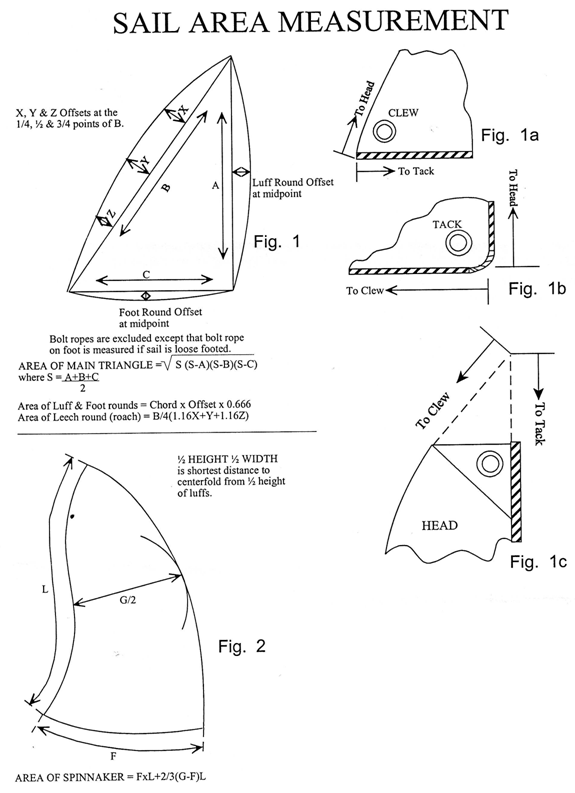
The combination of headsail and mainsail in use at any one time shall not exceed 20 square metres measured area. The sail plan is otherwise unrestricted.
The spinnaker shall be symmetrical when folded along its centreline with the leeches together. Maximum measured area shall be 20 square metres. Shape is otherwise unrestricted.
The measurement of sail area for the RL24 is based on the Australian Yachting Federation Racing rules q973-77,
Addendum E, Section IV. The basic method for mainsail and jib is measure lengths of luff, leech and foot
(these dimensions are used to calculate the ‘main triangle area’) and the offsets, or rounds of the luff,
leech and foot, which along with the first three dimensions are used to calculate the areas of the ‘rounds’,
which are added to the main triangle area to make the total. A hollow leech, as on some jibs, may be subtracted.
A spinnaker is measured folded down its centreline with the luff and foot measurements taken around the luff and foot.
The half height, half width is as shown in figure 2.
11. CREW
Crew unrestricted.
12. HIKING
No trapeze or similar device shall be used. Hiking is permitted, provided that when hiking in the transverse position no part of the crew’s body between the middle of the thigh and the feet shall be outboard of the sheerline. When hiking in the longitudinal position, at least one full arm and one full leg shall be inboard of the sheerline.
13. SAFETY EQUIPMENT
At all times RL24 yachts shall carry the appropriate safety equipment stipulated by Yachting Australia RRS requirements, or State yachting authority requirements which are current at that time.
14. BUOYANCY
Buoyancy in the form of sealed compartments or closed cell foam with a minimum volume of 0.55 cubic metres must be approximately evenly distributed fore and aft, and athwartships. Closed cell foam should not be used below bilge level.
APPENDICES
AT RL24 REGATTAS:1. KEELS – Swing keel division shall be restricted to yachts whose centrecases are as originally constructed prior to 1992.
Keels shall not be lifted beyond a point which leaves exposed 600mm vertical depth of keel, and a locking device shall be fitted to prevent raising beyond this point.
2. WIND SPEED FOR RACING (Recommendation only, not part of the approved class rules and a guide only to sailing committees).
The maximum average wind speed recommended by the class association is 30mph (approximately 48kph or 26knots)